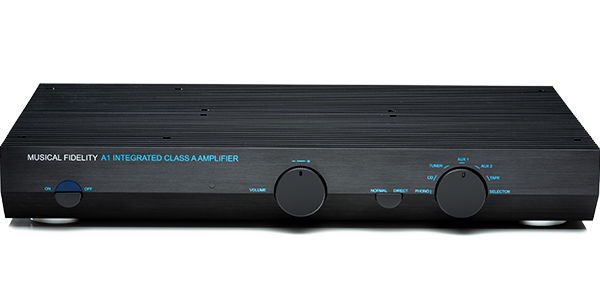
Musical Fidelity A1 Integrated amplifier
About the Musical Fidelity A1
Because of its enormous success, the A1 has undergone several reissues and new versions over the years.
For 2023, for the first time since the first release, we have retained all the specifications, looks and circuitry of the 1985 rendition for those who missed it the first time. With an updated transformer, power supplies and modern low-noise components, we have breathed new life into the formula and are proud to reintroduce the fresh original – three decades later.
The A1 in brief
25W pure Class A power @ 8 Ohm
Discrete symmetrical topology
Planar Audio transistors with a maximum output of 25A
Dynamic Class A, slides (does NOT switch) smoothly into Class B, allowing more current when needed
Therefore drives difficult loudspeakers with ease
Transformer updated to "dual mono split rail" windings
Fully independent left and right power supplies
Each power amplifier now has double the power supply capacity
Transformer noise and heat dissipation reduced
Filtered main supplies
Gain block before volume control fully bypassable using the "direct" switch
High-quality updated ALPS RK series potentiometer
Low-noise TL071 JFET preamplifier circuits
Discrete current-mode MM/MC phono input stage
Low-noise current-to-voltage converter for further amplification and RIAA equalisation
Automatic input impedance matching (1K nominal) for MC along with increased gain
Original (1985) A1 looks and circuitry with modern improvements
Remote control added for volume
Modern updated low-noise components
Technical details
The A1 is built around a fully discrete and symmetrical Class A topology. It can deliver 25 W of pure Class A power into an 8 ohm load, with a maximum output current of 25 A. Although the figures may seem rather low, the output stage's ability to drive difficult loudspeakers is a small wonder in itself. The amplifier's design is dynamic Class A, and when the Class A standing current is exceeded, it will automatically allow more. It therefore "slides" (does NOT "switch") smoothly into Class B style, temporarily allowing the necessary further current draw.
Power supply
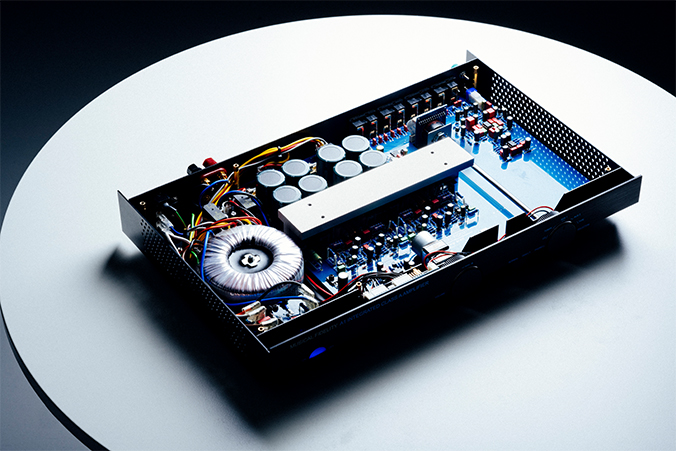
The new A1 has received an updated transformer, from shared (1985 original) to more efficient "dual mono split rail" windings. The amplifier stages are fed by fully independent left and right power supplies for better load handling and stereo imaging. Each power amplifier now has double the power supply capacity, resulting in less ripple and noise.
The transformer's noise and heat dissipation are reduced thanks to better efficiency and updated components. The main supplies are filtered for better regulation and lower inrush current.
Preamplifier
The low-noise preamplifier circuit is the same as the original 1985 design and, as highlighted above, benefits enormously from the improved, fully smoothed and regulated power supplies.
One of the noticeable changes is one that immediately catches the eye: the addition of a new "direct" switch in the preamplifier stage. This switch lets you fully bypass the gain block before the volume control, resulting in about 10 dB less gain. This feature proves particularly beneficial when working with modern or powerful digital sources, allowing the range of your volume potentiometer to be set precisely and sensitive loudspeakers to be accommodated.
In addition, a notable upgrade has been made to the volume potentiometer itself, which has now been replaced by a premium ALPS RK series potentiometer. This high-quality component provides superior performance and improved precision. What is more, the potentiometer is now motorised, so you can easily adjust the volume from your armchair, thanks to the new supplied remote control.
Phono preamplifier
The A1 uses a discrete current-mode input stage for the lowest-noise amplification of MC and MM cartridges. A low-noise current-to-voltage conversion stage is used for further amplification and RIAA equalisation. Automatic input impedance matching for the selected MC input, together with greater gain, increases the versatility of the A1's phono stage.
The return of a true hi-fi classic
The A1 has one secret. The secret is simple: it makes music. It sounds sweet and fluid and creates a beautiful atmosphere around natural instruments. Especially in small to medium-sized rooms, carefully set up with a pair of great two-way loudspeakers. It is not a powerhouse, but music lovers will cherish its capabilities.
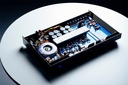
It is also not a product you want to hide. A perfect example of form follows function. The extra-large heatsinks define the look of the A1, but are essential to its operation. Truly unique, inside and out.
The A1 has a sweet, warm, full and exciting sound. No harshness. No graininess. Just pure music. It does not get muddy and, despite its lower power, drives difficult loudspeakers with ease. It stays clean right up to its power limit. To hear what the A1 does is to hear what hi-fi should do: make music, pure and simple.
The A1 through the years – improvements to the original
Transformer updated to more efficient "dual mono split rail" windings
High-quality updated ALPS RK series potentiometer as volume control
IR remote control added for volume
Gain block before volume control fully bypassable using the "direct" switch (-10dB)
All transistors, including output devices, are carefully selected modern equivalents
All capacitors in the signal path are of the polypropylene (PP) type.
Resistors are modern, low-noise metal film types
Care and attention have been taken not to change any component specification of the original, but to update them to a modern, long-life equivalent
The layout faithfully follows the original within the circuit sections on the circuit board
Circuit sections better laid out, in particular the separate power supplies and power amplifiers
Phono stage and preamplifier improved for less noise and hum
Musical Fidelity A1 specifications
Amplifier
- Power: 25 watts per channel into 8 ohms
- Voltage: 42.5 volts peak to peak
- Current: 25 amperes peak to peak
- Damping factor: 150
- Gain (maximum volume): 32 dB (direct mode), 42 dB (normal mode)
- Output devices: 2 per channel
- Signal-to-noise ratio: 82dB
- Channel separation: 85dB
- Frequency response: + 0, –1dB, 10 Hz to 40 kHz
- Line-level sensitivity: 300 mV rms nominal, 8 V rms max
- Line-level input impedance: 25k Ohm
- Tape output impedance: 220 ohms
- Pre-out impedance: 100 Ohm
Phono preamplifier
- Phono RIAA response: +/- 1dB
- MM sensitivity: 5mV nominal
- MM capacitance / impedance / gain: 100pF / 50k Ohm / 40dB
- MM signal-to-noise ratio: 75dB
- MC sensitivity: 450 μV nominal
- MC impedance / gain: 1k Ohm / 60dB
- MC signal-to-noise ratio: 70dB
Inputs
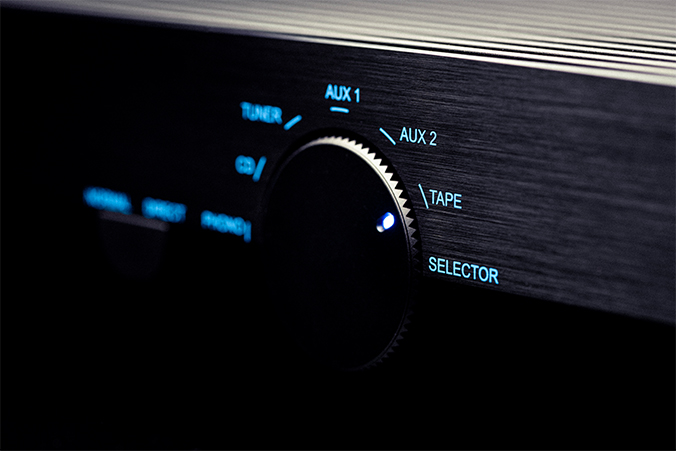
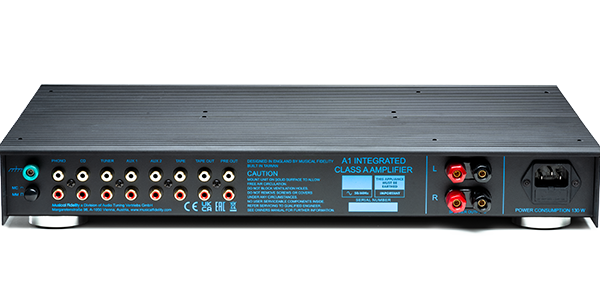
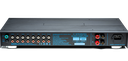
- 1x phono RCA MM/MC, 5x line RCA
Outputs
- 1 x line-level RCA fixed TAPE OUT
- 1 x line-level RCA var PRE OUT
- 1 x 4 mm banana/binding posts SPEAKER OUT
General information
- Dimensions (WxHxD): 440 x 68.3 x 283.3 mm
- Mains voltages: 230V/115V set internally or 100V optional
- Max. consumption: 130W, 0W in standby (= power switch OFF)
- Weight: 10.5 kg
Advice or a listening session
Would you like to hear this first? In our two listening rooms on Hoenderstraat in Maastricht, each with its own acoustics, we will set up the system for you. Make an appointment or call 043-7370028 — we are happy to help you find the right choice and the right placement.
Warranty
We guarantee that this product complies with the agreement, the specifications in the offer and the statutory provisions. Many brands also give their own warranty on their equipment. An additional warranty never limits your statutory rights: you can always rely on the law. Something wrong with your purchase? Contact us. Read more about warranty
-
Brand
-
Series
- Official dealer of Musical Fidelity
- 4.5 from 48 reviews on Google
- Free shipping from € 35 in the Netherlands, Belgium, Germany and Luxembourg
- Listen in our shop in Maastricht — also by appointment outside opening hours
- Questions? Call +31 43 737 0028