





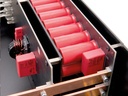


In-akustik Reference AC-4500 Power filter
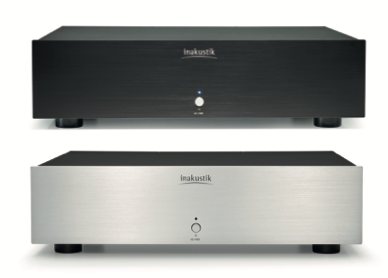
The In-akustik Reference Power Station AC-4500 is a power filter with six sockets for a clean, stable power supply. There is a basic model with one filter for all sockets and a full model with a separate filter for each socket. Separately shielded socket groups, all-pole mains disconnect switch, surge protection and a brushed aluminium front panel; 16 A (3680 W), approx. 450 x 386 x 122 mm, about 15 kg.
About the In-akustik Reference AC-4500
In reality, several factors have a considerable influence on the sound quality of audio systems, such as the power supply. This is subject to varying fluctuations, depending on where your home is (city or rural environment). Looking at it purely physically, the music a loudspeaker produces is ultimately nothing more than household current converted into sound. This statement sounds almost too mundane compared with the hi-fi jargon we are all used to, because it is of course more exciting to debate the quality of amplifiers, turntables or loudspeakers.
All too often we (unfortunately) ignore where the sound actually comes from, or the importance of a stable power supply. A "clean" current is therefore the raw material of fine sound, and our new Power Station AC-4500 takes care of that.
The new Power Station AC-4500
Several versions of the Power Station AC-4500 are available. There is a basic model with one filter for all six sockets, while the full model is fitted with six filters; in this configuration each socket has a separate filter. The models differ not only in the number of filters they have, but also in the filter type (1 & 2) configuration. The Power Station AC-4500 was developed entirely in-house. In addition, every unit is manufactured in the company's own factory and, once completed, undergoes strict routine tests whose results are recorded. We also engaged an accredited laboratory to verify CE/CB conformity, since safety is of the utmost importance for this type of unit. The Power Station's sensitive technology is packed into a robust metal enclosure of 2 mm thick galvanised sheet steel. The elegant front panel is made of brushed aluminium. The inside of the enclosure is also designed so that the socket groups are shielded from each other and interference from the connected devices cannot spread.
The power grid
We need electrical energy to run our audio system in the living room on the mains. This energy is produced in power stations (e.g. coal, hydro or wind power stations) and distributed to consumers via the electricity grid. Such quantities of energy can only be transported physically — via (overhead) high-voltage lines, underground cables or a combination of both. Energy is distributed at different voltages to minimise conduction losses in the grid. The higher the transmitted voltage, the lower the loss and the smaller the required cross-section of the transmission lines.
With extra-high voltage (1) of up to 380 kV, the power station transports the current through the transmission grid. Transformers in the voltage transformation stations are used to step the various voltage levels down. The high (2), medium (3) and low (4) voltage is then distributed to towns and villages until the 230V power reaches the end consumer, where it can be used by the audio system.
Grid distortion
Serious disturbances of the electricity grid are caused by, among other things, countless consumers — especially digital devices — and switch-mode power supplies, vehicle charging stations and photovoltaic systems. Increasingly, this is no longer limited to urban areas. This distortion causes serious problems in hi-fi components and can only partly be compensated for by the integrated power supplies and circuits. The rest degrades the audio signal and "veils" the sound produced by the audio system.
Not many people have their own power station. Most high-end enthusiasts are forced to use the overloaded electricity grid and, as mentioned earlier, the sound starts at the wall socket or, at best, at the fuse box. But even at the meter cupboard there is interference from all the consumers in your own home and in your whole neighbourhood connected to the grid. We see this when a lamp flickers when a hairdryer is used, or when the loudspeakers crackle as the fridge compressor starts or a fluorescent light is switched on.
Types of interference
In electrical engineering, a distinction is made between line-conducted interference and electromagnetic interference. Interference via the mains, also called push-pull interference, can be caused by switching devices on and off, via dynamic or synchronised consumers and power sources. This interference overlaps with the useful signal, spreads via the connected cables and ends up directly in the hi-fi components.
Electromagnetic interference, also called common-mode interference, can be generated by mobile networks, WLAN networks and Bluetooth devices, among others, and spreads through the air in the form of electromagnetic waves. In this environment, every device and every cable acts as an antenna and generates a voltage potential depending on the size of the field. The dimensions of the component and its distance from the interference source are some of the factors that determine the size of the field and the resulting potential.
As a result, each component of an audio system generates a different interference potential, leading to equalising currents that flow through the connected cables. These currents in turn interfere with the useful signal.
Tailored solutions
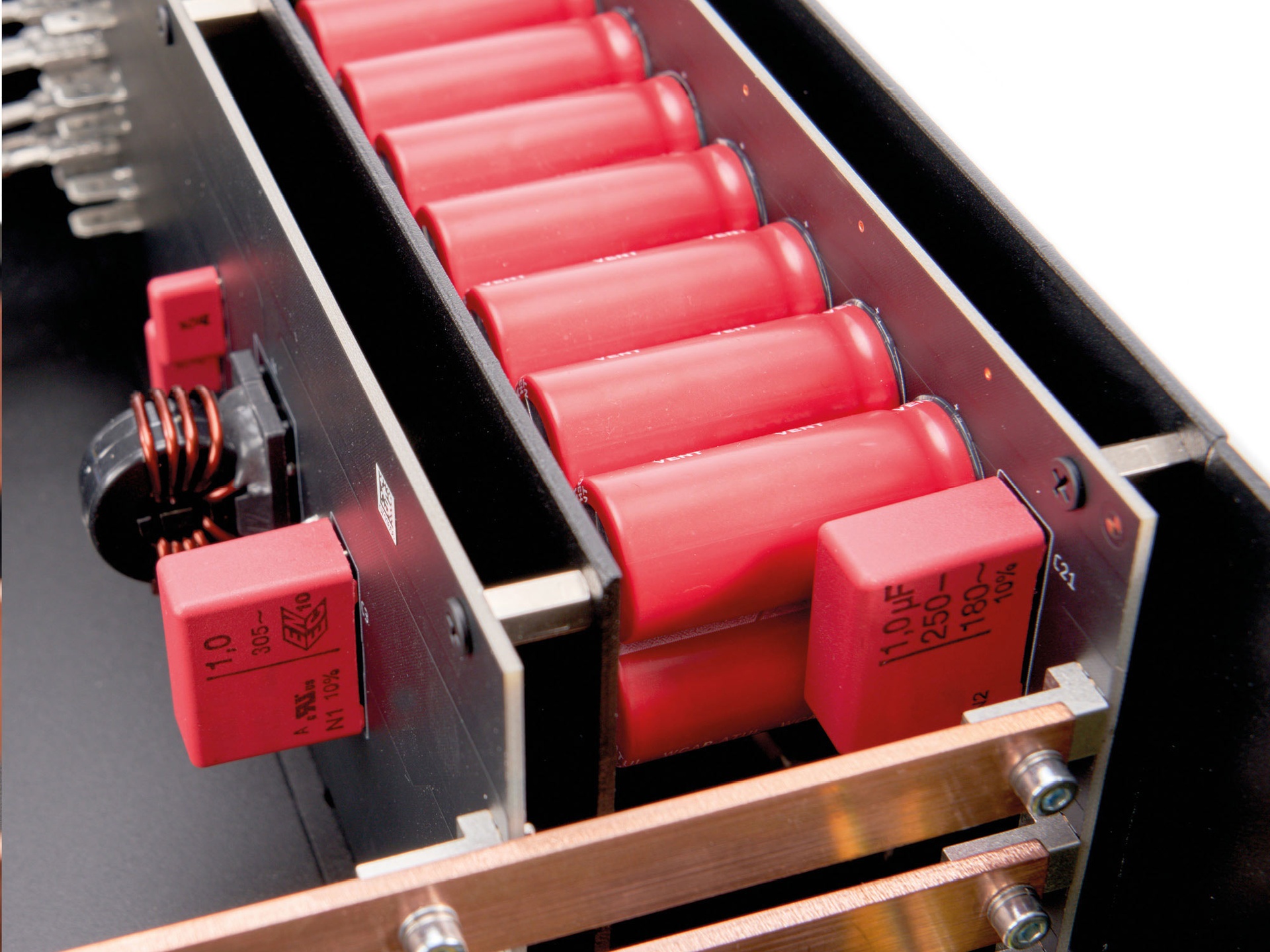
Ferrite cores are the first solution for correcting interference. They suppress HF common-mode interference thanks to their inductance-increasing effect. That is why the Power Station AC-4500 is fitted with powerful ferrite cores placed directly downstream of the sockets.
Custom filter circuits are another solution for minimising unwanted interference. It is crucial, however, that the filter type suits the application for which it is needed. Countless tests and measurements with different circuit configurations have shown that digital and analogue devices need different filter designs.
The Referenz Power Station AC-4500 is therefore fitted with two different filter types, depending on the configuration: type I for analogue devices and type II for digital devices. The filter design is completely different for the two types. Type I is a series filter network in which coils carry the useful current; these coils present a high resistance to interference. Type II, however, is a parallel filter network that diverts disturbing interference frequencies to earth. This filter network is also very finely tuned to hi-fi requirements.
The central core
Many household appliances use only one half-wave of the alternating current. For this reason, the 50 Hz sine waveform becomes asymmetrical and DC voltage components (DC offset) arise. This leads to an "asymmetrical" power supply to the connected hi-fi components, which in turn can lead to saturation of the devices' internal transformers. In addition to many adverse sonic effects and reduced efficiency, this also causes the transformer to make an irritating humming noise.
Powerful DC suppression, which filters DC components out of the power supply system, is at the core of every Referenz Power Station AC-4500. This ensures the connected devices are once again supplied with "symmetrical" current, which protects the transformers from magnetic saturation. This prevents adverse sonic effects and stops the transformer from humming. Thanks to the specially selected components, the DC suppression also makes a major contribution to high-quality sound.
We have also paid special attention to power distribution within the AC-4500. Distribution is based on a combination of solid copper busbars and special solderless high-current connectors. This design keeps the loop resistance extremely low, ensuring excellent current delivery capacity. This makes the AC-4500 a rock-solid foundation for the audio system, even at extremely high volumes and during dynamic passages.
In-akustik Reference AC-4500 specifications
- Separately shielded socket groups
- Brushed aluminium front panel
- All-pole mains disconnect switch
- Surge protection
- CE compliant
- Number of outputs: 6. Mains connection: IEC C-20 socket
- EU (Schuko): 230Vac (50Hz) | 16A (total) | 3,680W (VA)
- Protection class I
- Dimensions: approx. 450 x 386 x 122 mm
- Weight: approx. 15 kg (fully equipped)
Advice or a listening session
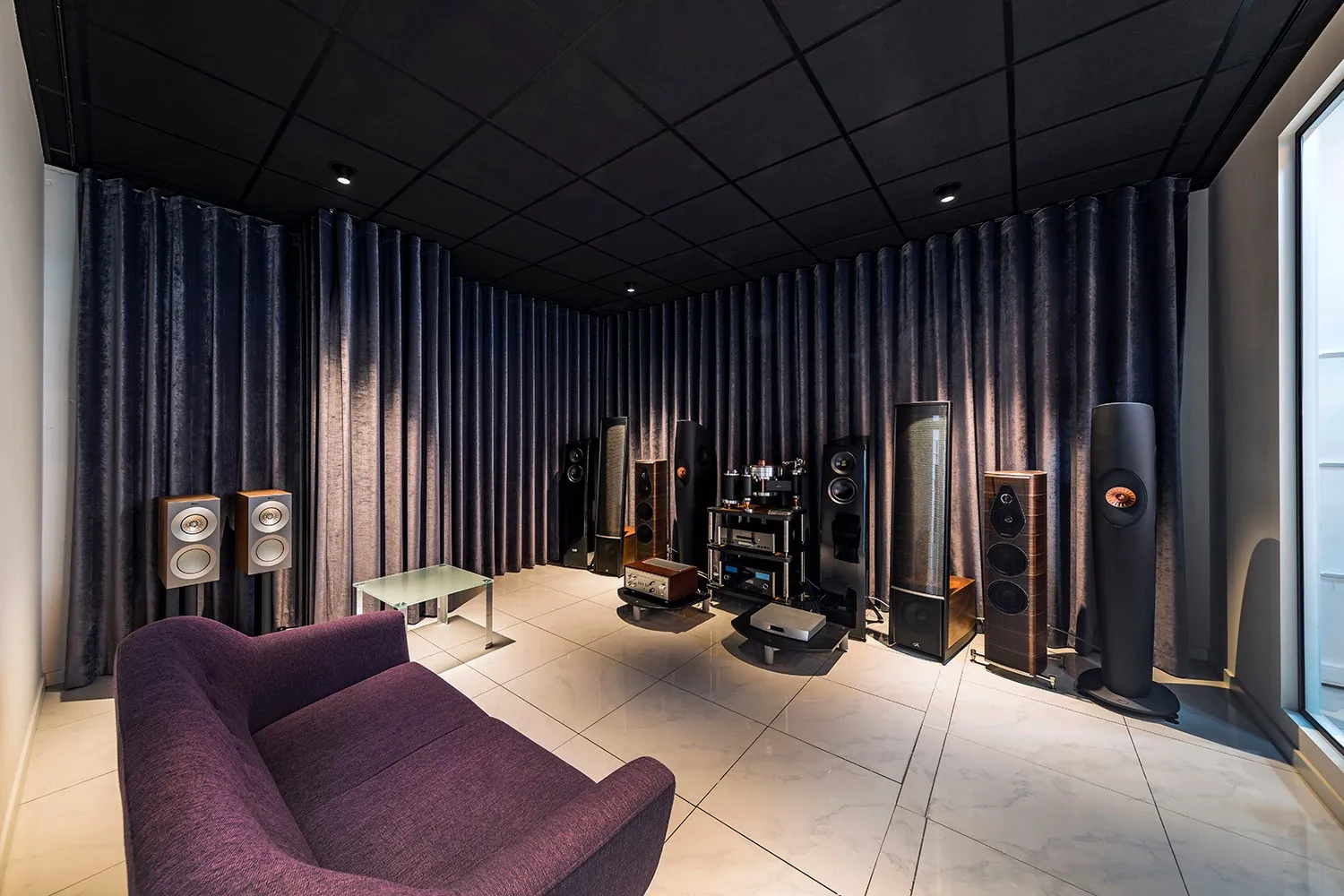
Would you like to hear this first? In our two listening rooms on Hoenderstraat in Maastricht, each with its own acoustics, we will set up the system for you. Make an appointment or call 043-7370028 — we are happy to help you find the right choice and the right placement.
Warranty
We guarantee that this product complies with the agreement, the specifications in the offer and the statutory provisions. Many brands also give their own warranty on their equipment. An additional warranty never limits your statutory rights: you can always rely on the law. Something wrong with your purchase? Contact us. Read more about warranty
-
Brand
-
Colour
-
Number of filters
- Official dealer of In-akustik
- 4.5 from 48 reviews on Google
- Free shipping from € 35 in the Netherlands, Belgium, Germany and Luxembourg
- Listen in our shop in Maastricht — also by appointment outside opening hours
- Questions? Call +31 43 737 0028